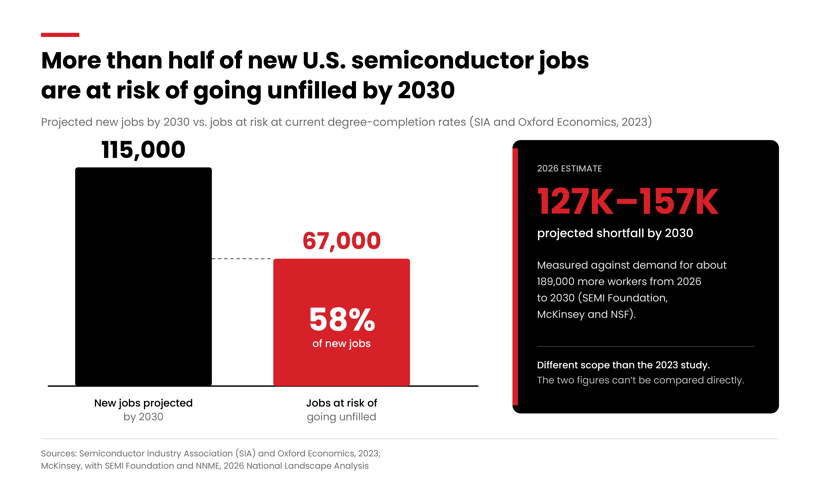
The semiconductor fab staffing shortage comes down to needing three things at once: the right specialized talent, in the right place, at the right time. Demand for semiconductor talent is growing faster than the supply of qualified workers. A 2023 Semiconductor Industry Association (SIA) and Oxford Economics study projected about 115,000 new U.S. semiconductor jobs by 2030, with 67,000 of them, more than half, at risk of going unfilled. Fab hiring demand can be predicted from project and tool-install timelines, but generic recruiting often starts too late to act on those predictions.
This is a people problem masquerading as a capacity problem. A company can finance a building and order tools in a quarter, but then it takes four to five years to produce an engineer.
Why is the Semiconductor Fab Staffing Shortage Growing? Demand Outpaces Supply.
The 2026 study projects that the U.S. semiconductor industry will need about 189,000 additional workers from 2026 to 2030, compared with a projected supply of about 62,000.
| Estimate | What it measures | Projected gap by 2030 |
| SIA and Oxford Economics, 2023 | New jobs at risk of going unfilled at current degree-completion rates | 67,000 of 115,000 |
| McKinsey, with SEMI Foundation and NNME, 2026 | Shortfall against demand for about 189,000 more workers from 2026 to 2030 | 127,000 to 157,000 |
These two studies measure different scopes, so the 2026 figure cannot be compared directly with the 2023 one. On the supply side, McKinsey estimated in 2024 that about 1,500 engineers and about 1,000 technicians join the U.S. semiconductor industry each year.
Three forces are making the shortage worse:
-
Experienced workers are retiring. One-third of U.S. semiconductor employees are 55 or older, and much of what they know about tools and processes was never written down.
-
New fabs are being built at the same time. SIA counts over 160 announced projects across 30 states, each project requiring its own install and operating teams.
-
More equipment needs more technical talent. AI demand is behind double-digit growth in fab equipment spending. Every tool has to be installed, commissioned, qualified and maintained by engineers and technicians.
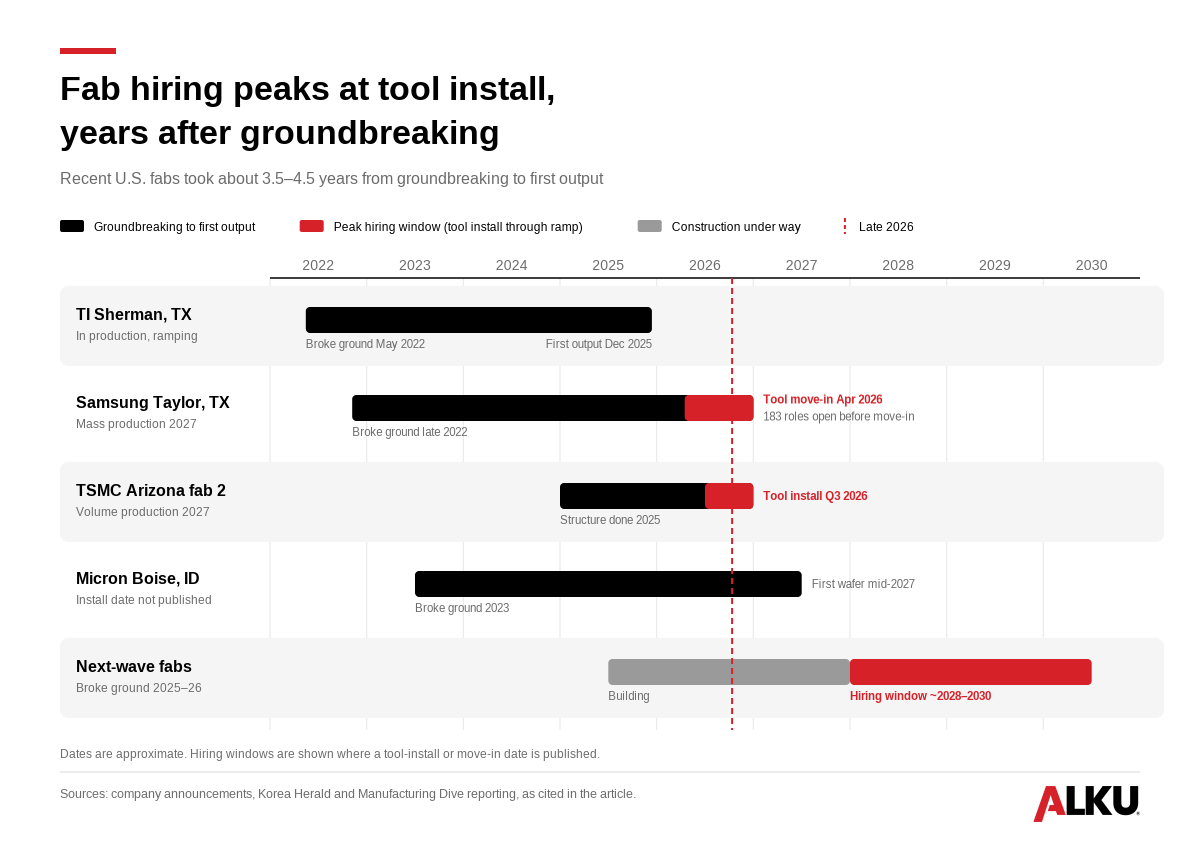
The Fabs Now Hiring Hardest Broke Ground in 2022 and 2023
Fab demand does not suddenly ramp up just because production started. The heaviest specialized hiring arrives around tool installation, commissioning, qualification and ramp. Those dates are well-defined years in advance. Recent U.S. fabs took about 3.5 to 4.5 years to go from groundbreaking to first output.
| Site | Broke ground | Status in late 2026 |
| TI Sherman, TX | May 2022 | In production since December 2025, ramping |
| Samsung Taylor, TX | Late 2022 | Equipment installation underway by spring 2026, mass production 2027 |
| TSMC Arizona fab 2 | 2022 | Structure done 2025. Tool install Q3 2026, volume production 2027 |
| Micron Boise, ID | 2023 | First wafer mid-2027 |
Hiring demand peaks in a narrow window around tool install. At Samsung Taylor, 183 roles were open across lithography, etch, deposition and metrology in the weeks leading up to move-in. In 2023, TSMC delayed its Arizona start by a year, citing a shortage of workers with equipment-installation experience.
A company that knows its tool move-in date knows roughly when it will need people, which means the pipeline can be built well before the requisitions open.
Training Cannot Catch Up Once the Crunch Starts
Fab staffing demand can rise within months. Developing a qualified technician or engineer takes months or years.
| Pathway | Time to job-ready |
| Short technician courses | 2 to 18 weeks |
| Micron technician apprenticeship | About 16 months |
| TSMC Arizona facilities technician | 36 to 48 months |
| TSMC Arizona process or equipment technician | 18 to 24 months |
| Engineer | 4 to 5 years |
If a company waits until the hiring crunch starts, training alone cannot fill the immediate need. Fabs that broke ground in 2025 and 2026 will hit the same window around 2028 to 2030. Their leaders still have time to plan.
Fabs Compete with Other Industries for the Same Technical Talent
Semiconductor manufacturers compete for electrical, mechanical, controls, commissioning and HVAC talent with data centers, aerospace, automotive and other industries. Staffing Industry Analysts reported in March 2026 that new data center projects need electrical, mechanical and HVAC engineers too, which are the same disciplines a fab build depends on. AI and automation are also changing which skills fabs need.
Generic Staffing Starts Too Late and Screens on Job Titles
Job postings for semiconductor engineers and technicians doubled to 25,000 in 2022, and the gap kept growing. More postings reach more people, but doubling the job postings doesn’t double the number of qualified people seeking new roles.
A volume approach hits three problems:
-
Job titles hide the requirements. As of October 2026, one Micron technician posting asks for two-plus years of equipment maintenance, rotating 12-hour shifts and full-time cleanroom garment wear. A keyword match on "equipment technician" screens for none of that.
-
It starts too late. Reactive sourcing begins when a requisition opens. Construction schedules and tool move-in dates show the demand many months earlier.
-
Supply is local. A national résumé database does not tell you who will relocate to Taylor or Boise, or who will work nights.
No staffing firm can create engineers, and that includes specialists. What a specialist can do is find the scarce experienced people faster and screen candidates from adjacent industries with more accuracy.
| Generic staffing | Specialized fab staffing | |
| Matches on | Job title and keywords | Tool, subsystem and project-phase experience |
| Starts | When the requisition opens | From expected ramp and tool-install timelines |
| Candidate source | Active applicants and résumé databases | Long-term relationships, including people not on job boards |
| Screens for | Résumé fit | Technical fit, cleanroom readiness, shift pattern and location |
A Specialized Partner Finds Transferable Talent and Builds the Pipeline Early
A specialist can widen the talent pool by knowing which experience transfers into a fab. McKinsey names pharmaceuticals, medical devices, aerospace manufacturing, power generation and automotive as source industries. Some military technical backgrounds, such as Navy electronics technicians and aviation electricians, can transfer too. A search on job titles or keywords may miss these candidates, and a specialist can start building that pipeline before the requisition exists.
This is how ALKU built its semiconductor division, which launched in May 2025 to focus only on this industry. Its recruiters work in semiconductors every day, so they know the roles: field service, installation, startup and commissioning engineers, plus equipment and design engineering. They also know two people with the same title can have very different experience, and they match on what the work requires. ALKU's consultants come from long-term relationships built over years, and many do not appear on job boards. "Talent is the biggest limiting factor," Andrew Bull, ALKU’s CEO and President, emphasized at the launch.
A global maker of deposition and epitaxy equipment needed engineers for real-time control software, subsystem design and factory integration. ALKU's semiconductor team placed six consultants across four disciplines, including equipment control software engineers with C++ and Pascal experience. ALKU reports their software work cut calibration and startup time on the client's epitaxy tools by 27%.
Fab Leaders Should Start Sourcing 12 to 18 Months Before Ramp
-
Give yourself 12 to 18 months. We recommend starting to source that far ahead of ramp because it gives an employer time to map the talent market, engage specialized candidates who are not actively looking, and account for relocation, shift requirements and any training before regional demand peaks. TSMC sent about 600 Arizona employees, a mix of US and Taiwanese workers, to Taiwan for 12 to 18 months of training before production began.
-
Align the hiring model to the phase. Use contract talent for install, commissioning and qualification, which end and often slip. Use direct hires for long-term process, equipment and yield ownership.
-
Choose a partner before crunch time hits. When several fabs in one region ramp at once, late hiring becomes a bidding contest.
Frequently Asked Questions
How long does it take to fill a semiconductor fab technician role?
There is no reliable national time-to-fill figure. Hiring an already-trained technician is far faster than developing a new one. Training can range from a few weeks for a short course to 36 to 48 months for TSMC Arizona's process and equipment technician programs.
What roles are hardest to fill in semiconductor manufacturing?
Engineers. In the 2026 analysis, 73% of employers (a sample of 30), nearly three in four, reported significant difficulty hiring engineers, compared with 48% for technicians.
How many workers does the U.S. semiconductor industry need by 2030?
A 2026 McKinsey analysis projects about 189,000 additional workers needed from 2026 to 2030, with a shortfall of roughly 127,000 to 157,000. A 2023 SIA and Oxford Economics study projected about 115,000 new jobs by 2030, with 67,000 at risk of going unfilled. The two studies measure different scopes.
How early should a fab start hiring before ramp?
ALKU recommends starting to source 12 to 18 months before ramp. Specialized hiring peaks around tool installation, commissioning and qualification, and those dates are known years ahead. Starting early leaves time to reach candidates who are not actively looking and to plan for relocation and shift requirements.
The shortage won't wait for your ramp date
The semiconductor fab staffing shortage is about the right talent, in the right place, at the right time. Tool-install dates show when that talent will be needed. The search can start long before the requisitions do.If your site is 12 to 18 months from tool install, talk with ALKU's Semiconductor Fab Solutions team about the roles you'll need and when.